Enter password to view
Monzo Billsback
Shaping a new subscription growth engine by reimagining the monthly bills experience
My role
Product Design Lead
Company
Monzo
Themes

Overview
As part of Monzo’s subscription strategy, we identified an opportunity to turn monthly bills into a new growth engine - creating moments of reward with the potential to drive acquisition and advocacy.
This led to Billsback, a new proposition that reimbursed customer bills and became one of Monzo’s most successful subscription launches.
I led design end-to-end, working with product, engineering and marketing from early concept through launch and iteration - including using AI tools to build and ship changes directly to production.

Framing the bet
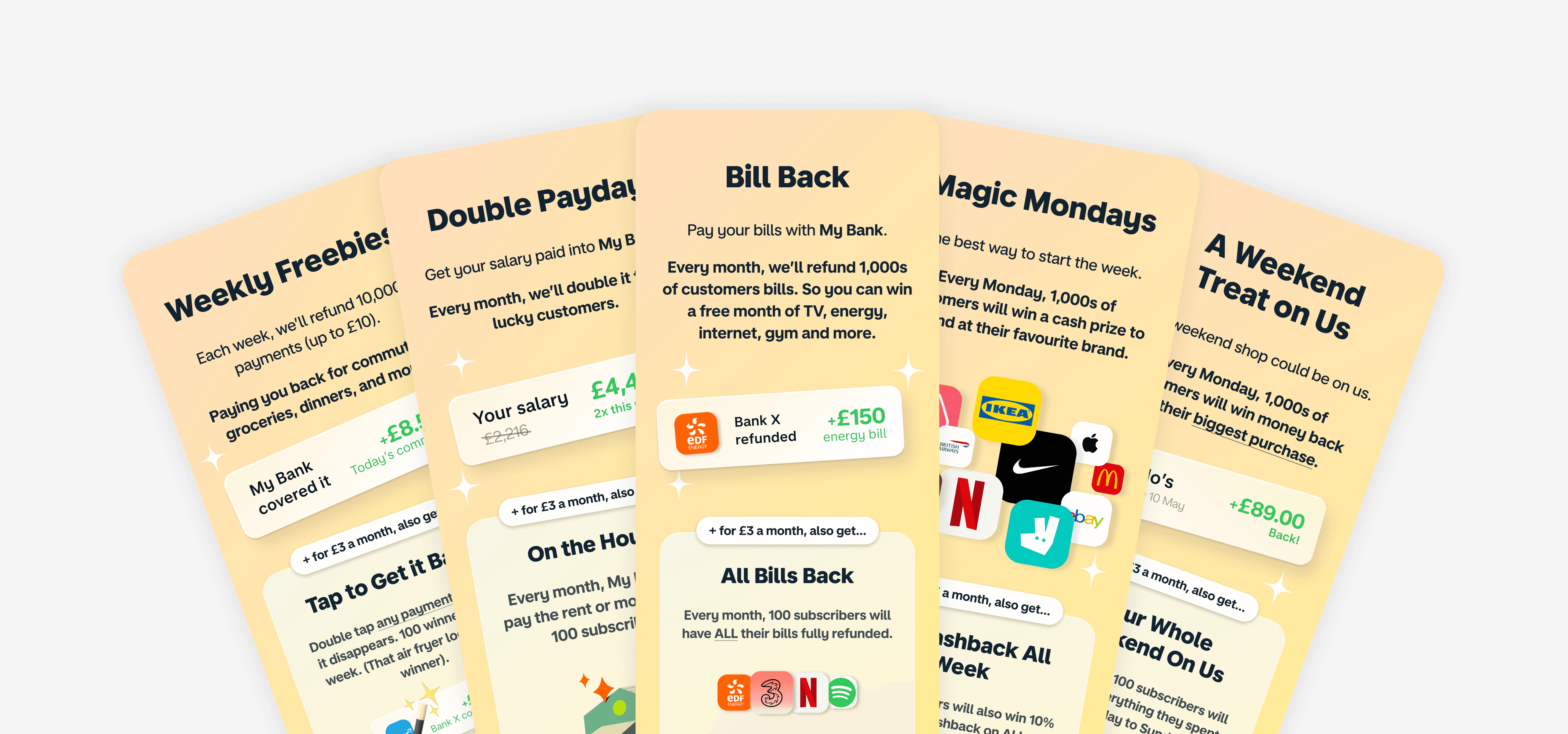
To evaluate how reward-led ideas could drive subscription growth, we used four lenses: virality, distinctiveness, practical value and clarity.
Using these, we prioritised five concepts from ideation workshops and tested them with customers - assessing whether they were compelling enough to talk about, valuable enough to participate in and simple to understand.
Two concepts outperformed the rest: Double Payday and Bill Back. Bill Back, which became Billsback, was prioritised for its strategic fit and ability to validate the viral growth hypothesis.
Mapping the opportunity space
Once Billsback was prioritised, the next challenge was turning a broad growth proposition into a focused first release.
I mapped the end-to-end customer journey - from discovery and sign-up through to moving bills and tracking progress, identifying where the experience needed to work hardest. This surfaced three priorities: education, trust and moving customers from interest to action.
I then explored the experience at low fidelity, working with the team to identify what to retain, improve and build on.
This shaped a focused first release that could validate the core growth hypothesis, while establishing a roadmap for future opportunities.


Designing the entry journey
With subscriber acquisition as the primary goal, the sign-up journey needed to create a strong hook while guiding customers clearly into the subscription funnel.
Monzo already had a proven two-step subscription upsell centred on the lowest-tier plan. Early in design, financial compliance raised concerns about combining the Billsback reward and subscription upsell on a single screen.
I reframed the constraint as an opportunity: could separating these moments improve both clarity and conversion? We tested two hypotheses - that a dedicated Billsback moment could better communicate value, and that a distinct plan-selection step using dynamic messaging could surface higher-tier plans.
User testing showed a clear preference for this approach. The final journey went on to deliver one of Monzo's strongest subscription conversion rates, with 36% of sign-ups choosing higher-tier plans, increasing average revenue per user.

Designing for trust under constraint
Post sign-up, Billsback needed to give customers confidence that it was working - particularly around which bills were eligible and entered into each monthly draw.
Early concepts explored surfacing live bill data, but engineering scoping showed this would add significant complexity and delay launch. Rather than optimise for data fidelity at the expense of speed, we de-scoped live tracking and focused on making eligibility explicit through clear communication.
This allowed us to ship on time and validate the core proposition. Live bill tracking was then prioritised post-launch, driving a 23% uplift in paid conversion.


We created a clearer path for customers to move more bills into Monzo, using simple steps, guidance and shortcuts tied directly to the Billsback proposition.
This increased bills paid through Monzo while connecting customers with budgeting tools such as Bills Pots and the bills calendar - helping Billsback drive deeper engagement beyond subscription acquisition.

The virality loop
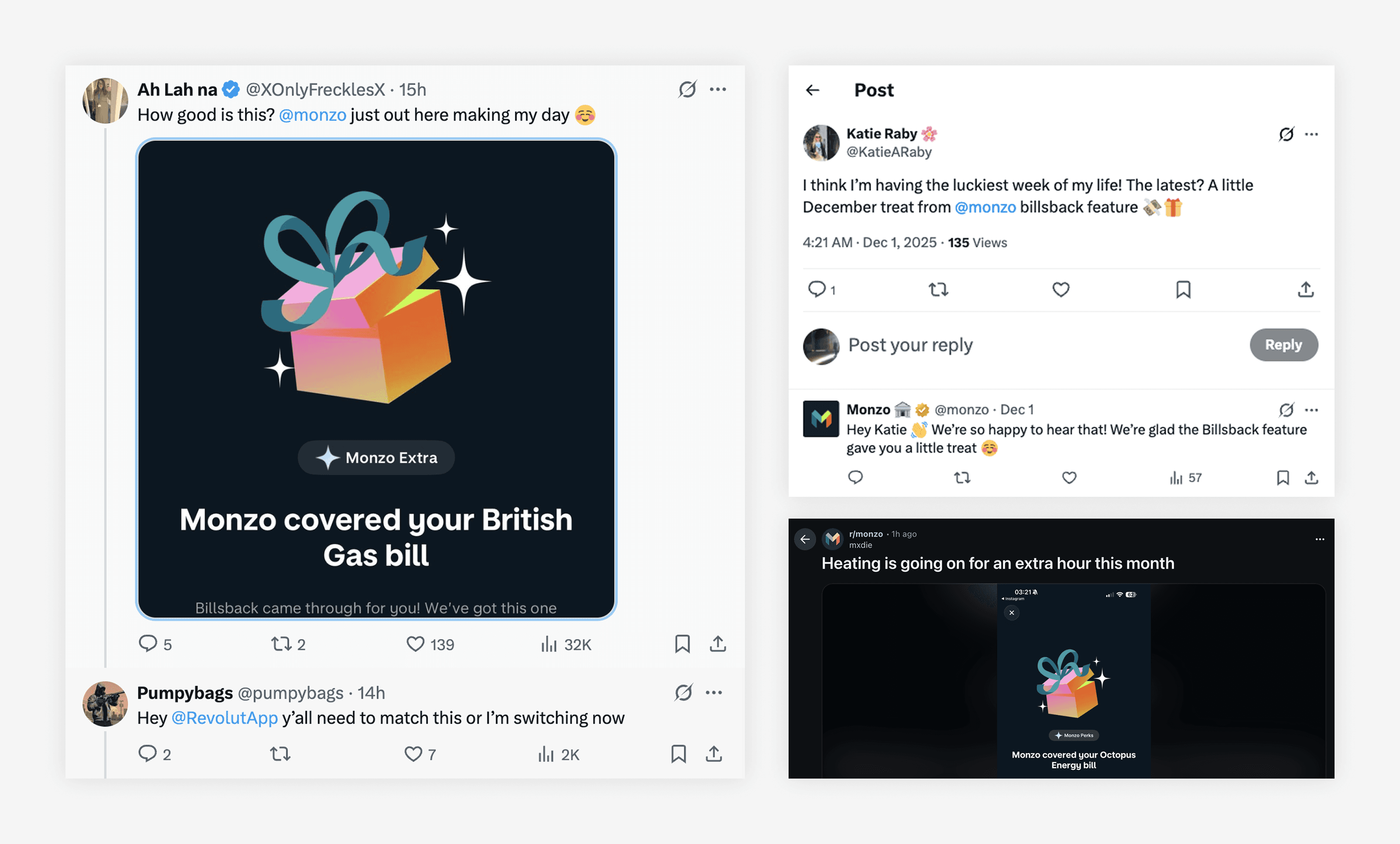
Virality was intentionally designed into the experience, starting with making winning unmissable. Customers were notified through push notifications and a celebratory full-screen moment designed to make the reward feel unexpected and worth sharing.

This drove significant organic sharing, with customers posting wins, comparing Monzo favourably to other banks and creating social proof around the proposition.
To turn that attention into growth, we introduced a lightweight sharing mechanic within Billsback, allowing customers to invite others to join Monzo or subscribe themselves - creating a direct path from reward to advocacy and acquisition.
Shipping to production with AI
Beyond the core release, I used AI tooling to take smaller Billsback improvements from design through to production code.
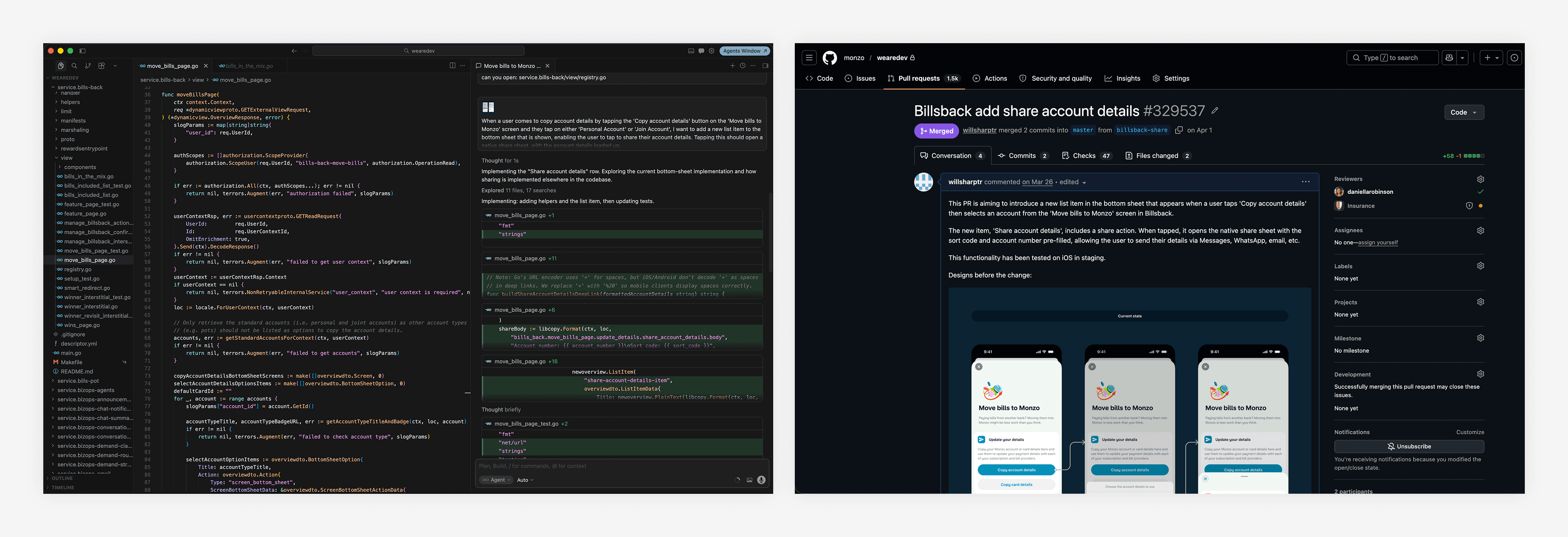
For instance, using Cursor, I worked directly in the product codebase to implement a customer-led improvement: a native share sheet that made it easier to send Monzo account details when moving new bills.
I implemented and tested the change, raised a pull request and responded to engineering review before merging it into production. This allowed me to move from customer feedback to shipped improvements with minimal engineering support.
Learning from launch
Billsback exceeded subscriber targets and generated high levels of organic conversation. Post-launch, I led a performance deep-dive combining 60+ customer support interactions with analytics across acquisition, funnel performance and bill migration.
The clearest insight was uncertainty: customers wanted greater reassurance that Billsback was working and that both existing and newly transferred bills were included.
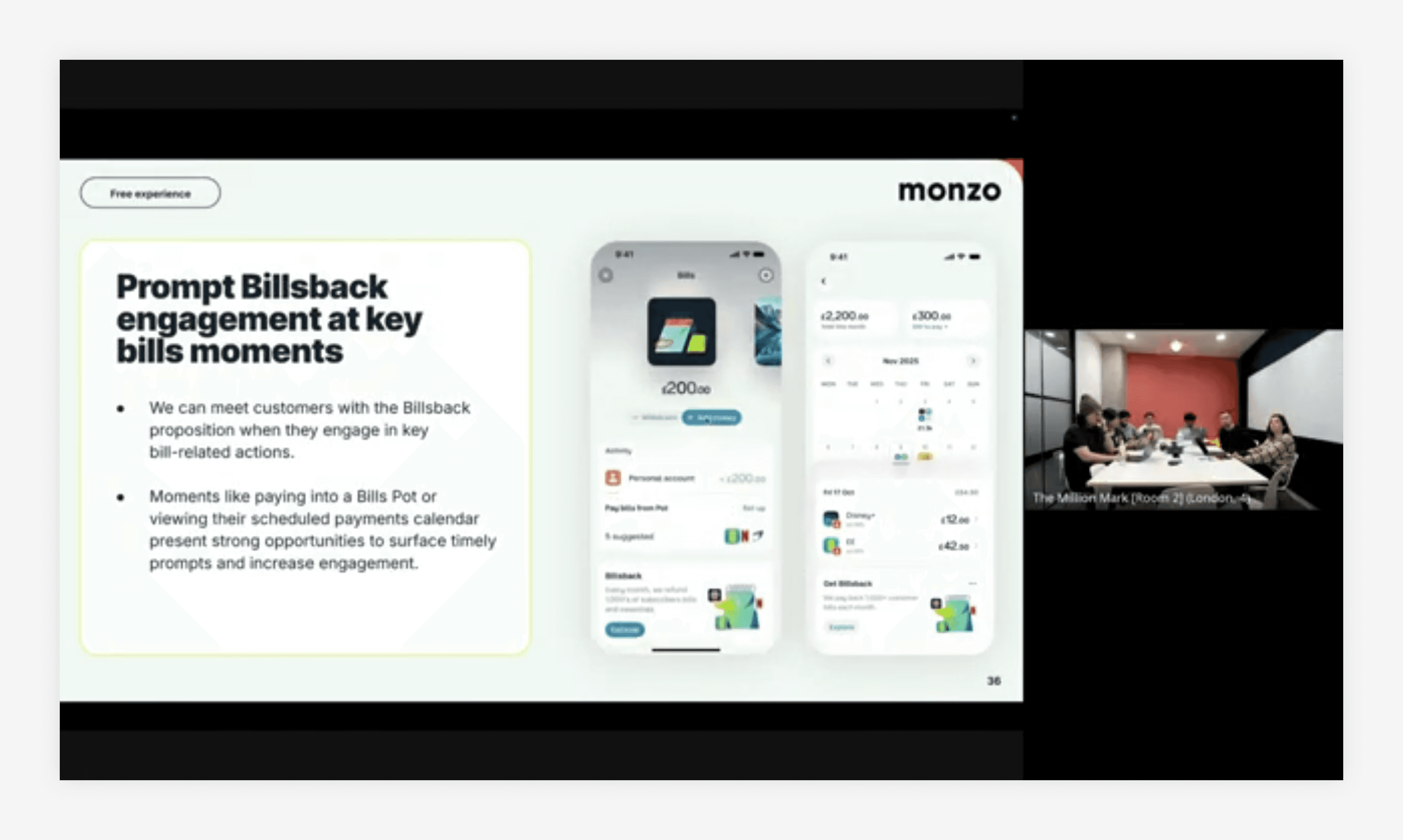
These insights shaped the next phase of work - including live bill tracking, contextual nudges to bring bills in from connected accounts and moments of new-bill celebration.

Outcome and impact
Billsback validated a new model for subscription-led growth at Monzo - one where customer delight, virality and core money behaviours reinforced each other.
By making deliberate trade-offs around scope and sequencing, we moved quickly, learned from real usage and built evidence for further investment. Billsback evolved from a successful launch into a long-term growth surface.